380 billion plastic bags
California is on the verge of approving a ban on plastic shopping bags, which has prompted a number of posts (here and here for example) on the subject of plastic bags. Living in Europe has taught me that I can’t assume that bags will be included in my purchase, so we either carry bags with us or ante up and buy new bags which we can then reuse later. (In Europe they typically cost us the equivalent of about 25 US cents each; in the US the usual figure is 5 cents when stores choose to charge or credit people.)
What is astounding to me is the sheer volume of bags and the related oil costs. (Yes, plastic bags come from petroleum, the same product that OPEC sells us to run our cars.) One site said that the amount of oil consumed just for plastic bags in the US is 10 times the oil spilled in the BP Gulf of Mexico disaster.
(The numbers here, again, are highly suspect: written estimates range from 1.6 billion gallons of oil to 38 million gallons of oil per year for plastic bags in the US. So someone needs to check their math. Also to note: the American Plastics Council has been quoted as saying that a ban on plastic bags would cost “tens of thousands of jobs” if it were implemented. Really, I don’t think so. Among other things, there would be a substitution effect. And even if it were true, we have tens of thousands of people working to create a polluting, energy consuming, and totally substitutable product? )
So, from personal experience, a plastic bag ban/tax/disincentive system is perfectly workable, and given the energy and environmental costs, it is an idea worth promoting.
Food and fuel: the logic of scale
Nice analysis of the true costs of feeding ourselves and the efficiency of our food production system is in a recent op-ed in the NYTimes by Stephen Budiansky. In short, he runs the numbers on how much it really takes to ship food across the country versus the “local food movement” idea that local food is better from a transportation, fuel, and pollution point of view. Turns out that local food isn’t really that efficient. The cost of shipping food across the country amounts to very little compared to the costs of even driving to the local farmer’s market. Of course local food may TASTE better, and that’s a different issue. But to assume there is a moral value to eating foods produced locally doesn’t hold up well.
The truth is, there are an awful lot of people in the world, and it is the collective actions of each of us as individuals that really have the impact on our energy consumption and environmental impact. According to the article, 32 percent of all energy use in our food system is from home preparation and storage. Transportation costs add up to 14 percent of the food system.
From a Long News point of view, I think this is another example of how we want to focus on “them” (in this case those California long-distance truckers) as the source of our problems, rather than figuring out how each of us contribute individually to the overall problem and how we address it. Seems like my best next move is to buy a more efficient refrigerator!
Oil Spill: The consequences of large project failure
Here’s a great Long News topic: we have environmental impact for sure, economic impact, and political impact — particularly in light of President Obama’s recent announcement for plans to open up the East Coast for drilling. I have to believe that those plans are now on indefinite hold.
It has been interesting to check out the regular news coverage on this one. The official BP home page is rather, well, official, with pictures of “boom”, a few short fact papers, and a overview of their response, including the process for any claims against the spill. Greenpeace, for contrast, has a horrifying picture of the original explosion, mentions 11 people that died (a fact which I had missed), and some insightful maps about the spread of the oil and what it would have done if it happened in other parts of the US, such as the East Coast. In the UK, the Guardian highlights the recent set of dead sea turtles that are washing up on the shore near the spill. Their article takes some pains to avoid jumping to conclusions, but the idea that this can just be mopped up with some big sponges or towed out to sea without harm is pretty much a dead idea. CNN International interviewed local people in the gulf about the impact on their livelihoods, including the guy who rents ski-doos. Oil on the beach means no tourists, and no tourists means no rental. That’s a pretty direct impact on a guy who probably didn’t even know there was an oil platform nearby.
Louisiana is one of the few states in the US that could be considered both pro-oil and pro-natural economy, with an economic dependence on both fishing and the petroleum industry. The combination of the two clearly can be disastrous for both. And unfortunately for Louisiana, they seem to be at the center of now two horrible environmental/people disasters, both involving human projects that didn’t work as planned (levees and oil platforms).
The long view on this story is, I think, the problem of how we can manage large technology projects for the overall benefit of people without these enormous consequences when the projects fail. BP is not a “bad” company in any way that I have seen: they have huge teams of people who I believe are really trying to do the right thing here, and there’s no indication that there was any negligence or ill intentions. Nevertheless, this is a hugely complex technology project, and we know that, regardless of intention, sometimes large projects go wrong. In this case, the consequences are enormous.
For better or worse, there are too many people in the world and too many projects that need to be done that we can’t just abandon all projects that have risks. The truest human challenge here is, how do we continue to pursue the technologies that we need without suffering the consequences of design and technology failures? Or is that just a pipe dream, and we are destined to live with the fact that bad things will inevitably happen — we should just push forward and ignore the consequences?
Where’s a serious discussion about health care?
This picture continues to upset me:
And it isn’t Sarah Palin, though I am not a fan. It’s the whiteface caricature of Barack Obama in the background. I know it is based on the Joker from the Batman movie, but I also know exactly why this particular image was selected. This particular photo is not unique to this picture; there are many other similar posters that are out there, at different rallies and in different circumstances. It seems to have been adopted by a segment of folks that are virulently anti-Obama, but to me this is not the normal political caricature. This is a racist caricature, pure and simple.
Several commentators have written about this phenomena, including Frank Rich most recently in the New York Times. There are people that are not against the health care plan per se; they are against Obama, or they are against a black man, succeeding in a societal initiative that they reject — or maybe it doesn’t matter about the initiative at all. So the reaction they have is to be offensive, to pull out the racial stereotypes and the content-free insults or to spit on Congressmen or whatever they feel like doing because they are wronged in some abstract way; someone else is getting something that they don’t get or wasn’t “earned” or whatever the case may be in their narrow-minded little heads.
If we want to debate the points of the healthcare proposal, let’s debate the health care proposal. I haven’t heard much in the way of a serious debate about why people should lose their health care because of the economic situation or their employer’s bad times. I am not sure why my top notch health care plan should be tax-free while millions of poor people have no coverage at all. These are points that can be discussed, and in fact they have been discussed, debated, and formed into a plan that has been voted on and approved in Congress.
But the whiteface racism, this offends me. It is hard to imagine a world where we can discuss long term problems and solve issues like climate change or poverty when a health care initiative can’t be discussed and debated without these visceral, offensive, and content-free reactions.
More good thinking from Michael Pollan
The New York Times has an interview with Michael Pollan linked to his new book, Food Rules. This is a great example of a Long News story as food, nutrition, and the eating habits of Americans certainly has changed over the long term and affects us all in very direct ways.
The idea here is that we could all use a set of easy-to-remember rules that would help us eat more wisely. I almost said “simple rules” but of course if they were simple we would all follow them without thinking. One of the problems Pollan highlights is that much of our challenge is about psychology: how do we convince ourselves to do the right thing, when the not-good thing is so easy to do?
One of the rules he likes is “Eat all the junk food as long as you cook it yourself”. The idea here is that things like potato chips and french fries are too easy and we would seldom take the time to invest to make them if we had to make them ourselves; the benefit would be is that we would eat better things instead. Right now I am trying to figure out how I could make my own M&Ms . . . .
Another longer article by Pollan that is certainly worth reading is “Out of the Kitchen, Onto the Couch”, about why cooking shows on TV are gaining in popularity while actual cooking is decreasing. If you have seen the recent movie “Julie and Julia” you’ll find this particularly timely.
Copenhagen’s lack of consensus
I have been reading some about the outcomes of the Copenhagen session on climate change. Most of the commentators suggest that not much happened and expressed their disappointment that no significant agreement was reached. What’s the long view? In this case, I think a huge amount was vested in the hope that a single big meeting, with representatives of dozens of countries with varying views, would miraculously solve a problem that is complex, controversial, and expensive to solve.
The truth is, many meetings and individual actions will have to take place before major change comes about to prevent global warming. For one, Americans are going to have to have to start trusting scientists. As one writer recently put it on this topic, are you going trust scientists or are your going to trust Glenn Beck? Somehow, some people believe that scientific facts are malleable to belief; that if we wanted to believe that gravity doesn’t always work or smoking doesn’t cause cancer or that people can levitate if they really put their minds to it, then that is OK. In this case, though the scientific consensus shows clear evidence of long term changes in the weather and in our ecosystem, too many people believe we should decide for ourselves if this is true or not, and that our opinion matters.
In this case, in the long run Nature will decide, and there won’t be a poll to see what we think.
Constant contact
I was struck today thinking about a long term change that has taken place in our personal lives — that of keeping in constant contact. The newspaper had articles recently about a trolley driver in Boston who was texting someone while driving the trolley; the resulting crash injured 49 people. On a more mundane level, I was just in Vienna taking a taxi to my hotel, when a taxi driver missed my exit and ended up driving across a river and back before depositing me successfully at my location — because his wife had called him while he was driving me and caused him to forget my exit. And sure, I love myself to keep in touch, to call my wife from Vilnius or Bratislava or wherever and to talk about my son’s ballgame or what the dog is doing.
Keeping in touch is something we all like to do. Historically, though, a hundred years ago, people might keep in touch via written letters which could take weeks or months to be delivered. After the mid-nineteenth century, urgent news could travel by telegram, which was expensive and usually contained only the worst possible news, such as a son dying in battle or the loss of loved one. Still, until around 25 years ago, constant contact was expensive and required expensive and uncommon equipment.
Now, of course, constant contact is ubiquitous and nearly free. Texting costs pennies, twitter and facebook and gmail are basically free anywhere in the world. Everyone can keep in touch any time, anywhere. Clearly, though, when it comes to safety, cell phones for trolley drivers should clearly be left at the office. But for others, perhaps a bit of thought and consolidation is in order. When we have a chance to reflect a bit, rather than just react or post something without filtering, the quality of our interactions improves and the value of the information increases. In a world where it is all too easy to be buried in a flood of low-level unfiltered data points, the value of a more thoughtful and reflective view becomes significantly more estimable.
The Great Disruption
Tom Friedman has an excellent editorial, as he often does, in today’s New York Times. He suggests that the economic crisis that we are facing may be a great disruption point, where the business-driven growth model that drives our economic philosophy and approach hits up against the fundamental limits of both our funding model and the overall ecological system of our planet. That is, there ain’t enough money and resources available to keep growing forever in the same unsustainable way we are today. The more I read, the more I am coming to believe that the fundamental idea we have to face is waste vs. sustainability. How do we have economic, political, sociological and business systems that are designed to minimize waste and maximize stability?
Now I am not sure that there is direct link between the banking crisis and the challenge of waste vs. sustainability, but then again, maybe there is. One major proximate cause of the banking crisis was that people were driven to take out more loans against larger houses than they could afford. People were encouraged to take out second mortgages to buy more stuff that they couldn’t yet afford. When it all started to unravel, the banks were unable to manage through it and here we are. Maybe if we all had kept our cars and TV sets a little longer, we might not have pressed the growth of the economic system as hard as we did, and we might have escaped the system failures that we are now experiencing.
As a sidenote, Friedman also points to a blog, climateprogress.org, that takes a good look at climate issues and environmental stability. A brief look at it suggests that that blog is thinking along the lines of the longnews point of view. Worth a longer look.
Let’s see what the “News” brings today
So, let’s take a look at today’s CNN “News”. Not to pick on CNN, but a great illustration of the paucity of high-value information available in the news today:
Ok, the Obama address, that is news. But “Elk wears bar stool around neck?” Don’t think so. The octuplet story has generated a lot of discussion at our home about medical ethics and what the role of government is in preventing people from doing things that aren’t in anyone’s best interest. But the “snipefest”? No way. Surf tips? Hardly news. Tiger Woods on his latest round? Entertaining perhaps, hardly of long term value.
The air crash, clearly this sounds like news, and I suppose it is. But again, the 9 people that were killed in the air crash are dwarfed by the more than 100 people that will be killed in the US in auto accidents today.
I loved the very first link to “Galaxy may be full of Earths, alien life”. Sure enough, it may be. Now, if someone had DISCOVERED alien life, that would be news! But I don’t think that the idea that the galaxy “may be” full of Earths is something that just came up new today. And, to be fair, it may also be empty of Earths and alien life. So far, no real evidence exists to support either one! Any new facts here would be news, but in this state, I am not sure what the value may be from this.

Long Term thinkers: Kevin Kelly
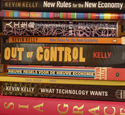
I’ve never met Kevin Kelly but he has clearly been an influence on the ideas behind The Long News. I still have my original copies of the Whole Earth Catalog and Signals, and subscribed for a long time to the Whole Earth Review. Kevin’s work shows a strong interest in early trend identification and getting useful tools into the hands of the people that need them, both areas which the traditional media rarely emphasize.
Kevin has a nice index of all his projects on his website, kk.org. I am particularly fascinated by his Cool Tools listing, almost all of which could have been fun/useful 25 years ago, or likely to be 25 years from now.
Kevin is also one of the board members at The Long Now Foundation, a group which I posted on earlier in this blog.
